Alo Yeditepe

Turkish Scientists Discover A New Cell In The Thyroid Gland
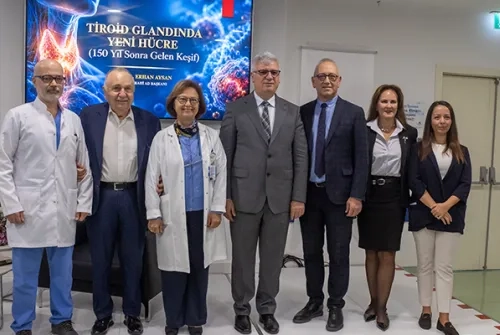
A fundamental piece of knowledge that has been included in medical textbooks for approximately 150 years is changing with a discovery made by Turkish scientists. Prof. Dr. Erhan Ayşan and his research group from the Department of Endocrine Surgery at Yeditepe University have made a game-changing breakthrough in the world medical literature by identifying a new cell type in the thyroid gland that secretes parathormone. The discovery also provides a scientific explanation for the hitherto unexplained questions of low parathormone after thyroid surgery and why hormone levels do not drop to zero even though all parathyroid glands have been removed. This discovery is also expected to pave the way for significant changes in many areas, from thyroid surgery to early diagnosis and new treatment approaches in thyroid diseases.
Yeditepe University Endocrine Surgery Specialist Prof. Dr. Erhan Ayşan stated that this discovery is not limited to merely identifying a new cell, saying: “Basic physiology and histology textbooks contain the information that ‘Parathormone is secreted only by the parathyroid glands.’ We, however, have identified a new group of cells within the thyroid gland that secrete parathormone, and we have succeeded in imaging these cells. This discovery changes one of the fundamental pieces of knowledge in medical education.”
Fundamental knowledge that has existed for 150 years is changing
Stating that until now it had been accepted that only two cell types exist in the thyroid gland, Prof. Dr. Ayşan said that medical school textbooks describe the follicular cells that secrete T3 and T4 and the parafollicular cells discovered approximately 150 years ago in the thyroid gland. Noting that with this new research they have identified a third cell type within thyroid tissue, Prof. Dr. Ayşan said: “Until now, it was accepted that parathormone is secreted only by the chief cells in the parathyroid glands. Our study has revealed that the thyroid gland can also produce parathormone. Thus, both a new cell type has been identified, and the fundamental knowledge that parathormone is secreted only by the parathyroid glands has changed.”
The discovery answers many questions in thyroid surgery
According to Prof. Dr. Ayşan, the discovery has not only theoretical but also important clinical implications: “In a successful thyroid operation, even though the parathyroid glands were left in place, parathormone levels were dropping in some patients, and the reason for this could not be fully explained for years. We now know that the real cause of this situation is that these new cells within the thyroid gland are also being removed together with the thyroid tissue.”
Similarly, Prof. Dr. Ayşan stated that this discovery also sheds light on why the parathormone level does not drop completely to zero in patients in whom all parathyroid glands have been removed, using the following words: “After these operations, we surgeons constantly carried the thought: did we leave something incomplete in this patient? Our study shows that the parathormone secreted from thyroid tissue provides a very clear explanation for this situation.”
A new era may begin in thyroid surgery
Stating that this discovery may open a new approach algorithm in thyroid surgery to discussion in the coming years, Prof. Dr. Ayşan said that organ-preserving thyroid surgery will gain more importance. “From now on, we surgeons will have to think more carefully about removing the entire thyroid gland. In some patients, instead of removing the entire thyroid gland, thyroid-preserving surgery that leaves the healthy parts of the thyroid gland in the patient’s body may be preferred. This approach will significantly increase our patients’ quality of life by minimally affecting natural hormone secretions,” he said.
Medical school textbooks may be rewritten
Stating that this discovery will bring about some changes in the basic medical sciences, Prof. Dr. Ayşan said: “The information ‘Parathormone is secreted only by the parathyroid glands’ found in physiology and histology textbooks will now have to be updated. The discovery of a new cell is a very rare event in the history of science. After approximately a century and a half, fundamental knowledge about the thyroid gland is changing.”
It may open the door to early diagnosis and new treatments
Stating that the new discovery will also be the beginning of many studies, Prof. Dr. Ayşan said that the roles of these cells in thyroid cancers in particular, as well as in Hashimoto’s disease, Graves’ disease and thyroid inflammations, will be investigated. “Once it is revealed in which diseases these cells increase or decrease, early diagnosis methods can be developed in light of these data, and new treatment options may come to the fore. It is difficult to predict at this point what the research to be carried out on these subjects will bring. The tower of science rises slowly as small bricks are laid. As research is conducted and results emerge, we will all see together how the picture evolves,” he said.
This discovery is the product of years of work by a multidisciplinary team
Stating that this important discovery is not an individual achievement but the result of many years of work by a large research team, Prof. Dr. Ayşan said the following on this subject: “Today, science and technology have advanced greatly. The amount of knowledge has increased enormously. It is not possible for one person to master this much knowledge and produce significant scientific knowledge. We are aware of this. For this reason, we have a large research group, working together for years, consisting of basic sciences, engineering sciences and clinical sciences. To date, we have published many scientific articles on the thyroid and parathyroid glands and obtained many patents. If you pay attention, today major scientific discoveries always bear the signature not of individuals but of large, multidisciplinary teams. Our discovery is the same. Today we are experiencing this pride not individually but as a team. Every researcher in our team has put in at least as much effort as I have in this process. Had we not been together and had we not put forth teamwork, we could never have reached this point.”
What will this discovery change?
- The thyroid gland is not a tissue that secretes only the hormones T3, T4 and Calcitonin.
- Parathormone is not secreted only by the parathyroid glands.
- Organ-preserving approaches will be applied more frequently in thyroid surgery, thus increasing patients’ quality of life after thyroid operations.
- The cause of low parathormone seen after thyroid surgery has been explained.
- The reason why parathormone in the blood does not drop to zero in patients in whom all of the parathyroid glands have been removed has been explained.
- A new era may begin in the diagnosis and treatment of common thyroid diseases such as thyroid cancers, Hashimoto’s and Graves’.
- New biomarkers for early diagnosis may be developed.


This content was prepared by Yeditepe University Hospitals Medical Editorial Board.