Alo Yeditepe

What Are the Symptoms of Scabies? How Does Scabies Resolve?
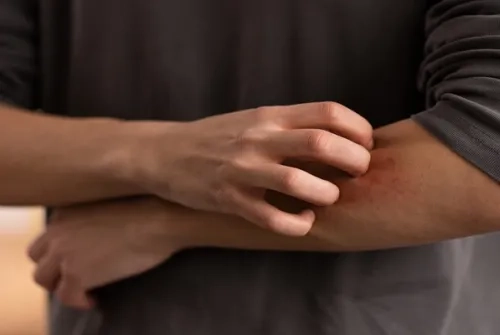
Scabies is a contagious skin disease caused by a microscopic mite. The mite settles in the upper layer of human skin, where it forms tunnels and lays its eggs. As a result of the immune response the body develops against this parasite, intense itching that becomes especially pronounced at night and various skin lesions appear.
The disease can be seen in every age group. The emergence of scabies does not mean that personal hygiene is inadequate; it can also be seen in people living under different conditions. However, close and prolonged skin contact, living in the same household, and crowded living environments can facilitate the spread of the disease.
Scabies is a condition that can be controlled with appropriate treatment in most patients. However, delayed diagnosis, failure to evaluate close contacts, or failure to apply treatment as recommended can cause the disease to be transmitted again between people. For this reason, scabies should be evaluated not only based on the skin symptoms appearing in the person, but also by taking into account the patient's close environment and contact history.
What Causes Scabies?
The causative agent of scabies is the mite Sarcoptes scabiei var. hominis, which can live on human skin. The female mite advances in the upper layer of the skin, forms tunnels, and lays its eggs in these tunnels. The mites that hatch from the eggs continue their development and become adults. In the emergence of disease symptoms, not only the presence of mites on the skin but also the immune response the body gives against them plays a role.
Scabies should not be associated with lack of hygiene. Cleaning habits are not the main cause of the disease. The disease can be transmitted as a result of sufficiently long and close physical contact with an infected person. For this reason, it is possible for it to be seen in more than one person among people living in the same family or in environments where close physical contact is intense due to care needs. The disease can spread more easily, especially in communities with crowded living conditions.
How Is Scabies Transmitted?
The most important route of transmission of scabies is direct and close skin contact with an infected person. Short-term, ordinary contacts are not thought to play a primary role in the transmission of the disease. In contrast, sleeping in the same bed, prolonged physical contact, sexual contact, or close contact during personal care may be important for transmission. Transmission through items such as clothing, towels, and bed linen is a lower probability in classical scabies compared with direct skin contact. However, in the severe form of the disease called crusted scabies,
since the number of mites on the skin is much higher, the risk of environmental transmission may increase. This situation is especially important for healthcare institutions, care centers, and crowded living areas.
What Are the Symptoms of Scabies?
The most prominent clinical finding of scabies is intense itching. In most patients, itching increases especially at night and can reach a severity that disrupts sleep patterns. This is due to the immune response the body develops against the mite and mite products.
Intense Itching That Increases Especially at Night
Scabies symptoms may not always be noticed immediately in the initial period. The onset of scabies may vary depending on whether the person has had scabies before.
Itching is the most prominent symptom of scabies and the one that most affects patients' daily lives. Itching usually becomes pronounced in the evening and at night; in some patients, it can be severe enough to disrupt sleep. In people with scabies for the first time, the emergence of itching can take several weeks after infection.
In people who have had scabies before, symptoms may begin earlier due to the immune system responding faster because of the previous encounter. It should not be forgotten that itching alone is not sufficient to diagnose scabies, but it is an important finding, especially when evaluated together with typical skin lesions and a history of close contact.
Small, Itchy Bumps on the Skin
Scabies symptoms can also be seen in the leg area. Itchy bumps and redness in the leg area should be evaluated together with other skin findings and the person's contact history.
In scabies, small, reddish, or skin-colored bumps may appear on the skin. These lesions are usually seen together with marked itching and can be found in different areas depending on the disease's location on the body. The spaces between the fingers, wrists, armpits, waist area, buttocks, and genital area are among the frequently affected areas in adults.
Due to continuous scratching, irritation, scratches, and superficial wounds may also develop around the bumps. However, such skin lesions are not specific to scabies alone; since similar appearances can occur in different dermatological diseases, physician examination is required for a definitive evaluation.
Thin Line or Tunnel-Like Marks
One of the more characteristic skin findings of scabies is the thin tunnels that the mite forms by advancing in the uppermost layer of the skin. The female scabies mite leaves behind a narrow and winding passage as it advances in the superficial layer of the skin. For this reason, it can be noticed on the skin as a thin line or thread-like mark a few millimeters long. Tunnels can sometimes appear skin-colored, grayish-white, or slightly reddish and are more clearly visible especially between the fingers and on the wrists.
At one end of the tunnel, a small bump or dark dot may also be noticed. However, due to intense scratching, these marks can easily become irritated and their appearance may change. For this reason, a distinct tunnel is not expected to be seen in every patient. Evaluating this finding together with itching that increases especially at night and other skin lesions in typical areas is important for the diagnosis of scabies. However, it should not be forgotten that not every thin line on the skin is a scabies tunnel; definitive evaluation should be made by a dermatology specialist.
Lesions Between the Fingers and on the Wrists
Among the areas where the mite prefers to settle in scabies, the spaces between the fingers and the wrists hold an important place. In these areas, small, itchy bumps, redness, and thin tunnel-like marks formed by the mite in the upper layer of the skin may be seen. It is noteworthy for scabies that lesions appearing especially on the lateral sides of the fingers and the skin between the fingers are accompanied by intense itching. On the wrists, small bumps and line-shaped tunnels may be found together.
With continued scratching, the development of irritation, scratching, and superficial wounds on the skin in these areas is also possible. However, the presence of lesions only in these areas is not sufficient for the diagnosis of scabies; findings must be evaluated together with itching that increases especially at night, skin changes in other parts of the body, and the person's history of close contact.
Symptoms in the Armpit, Waist, Buttocks, and Genital Area
Scabies symptoms can also appear in the armpit area. In this area, small, itchy bumps, redness, and in some cases thin tunnel-like marks may be seen.
Scabies can cause skin lesions in different parts of the body, and the armpits, waist area, buttocks, and genital area are among the areas that can be affected by the disease in adults. In these areas, small, itchy bumps, redness, and sometimes thin tunnel-like marks formed by the mite in the upper layer of the skin may be seen. Itching that becomes pronounced especially at night may accompany these skin changes.
Lesions occurring in the genital area may be more prominent in some patients, and irritation or superficial wounds may develop on the skin as a result of intense scratching. However, it should not be forgotten that not every itchy rash seen in these areas is caused by scabies. When making a diagnosis, the appearance and distribution of the lesions, as well as the characteristics of the itching, findings in other parts of the body, and the history of close contact should be evaluated together.
Skin Changes Due to Scratching
The intense itching that occurs in scabies, especially when it worsens at night, can cause the person to scratch their skin frequently and forcefully. As a result of continuous scratching, scratches and abrasions, redness, irritation, scaling, and superficial wounds may develop on the skin. These changes due to scratching can also alter the appearance of existing skin lesions over time and make it difficult to notice the specific findings formed by the mite. In areas where skin integrity is disrupted, the risk of secondary skin infections developing due to bacteria settling may also increase. For this reason, it is important to perform a medical evaluation especially in cases accompanied by findings such as inflammation, marked pain, discharge, or progressively increasing redness. Skin changes due to scratching alone are not specific to scabies. The diagnosis should be evaluated together with other clinical findings and the person's history.
Lesions in Different Areas in Children
Scabies can cause symptoms in children in different areas and with different appearances than in adults. In infants, scabies symptoms can be seen in areas such as the palms, soles, and scalp.
The skin findings of scabies in children may differ from the typical location seen in adults. Especially in infants and young children, small, itchy bumps and sometimes tunnel-like lesions may be seen on the palms and soles. The head and neck area is also among the areas that can be affected by the disease in young children. In older children, similar skin findings may appear between the fingers, on the wrists, in the armpits, and in other parts of the body. Due to intense scratching, the development of scratches, scaling, and irritation on the lesions is possible.
The fact that rashes are seen in different areas and more widely in children can cause scabies to be confused with other skin diseases. For this reason, it is important to evaluate itching that increases especially at night, the presence of similar complaints in the family or the child's close environment, and characteristic skin findings together. It should not be forgotten that scabies treatment to be used in children may vary according to age and body weight, and treatment should be applied in line with the physician's recommendation.
Scaling and Thickened Skin
Scaling and marked skin thickening are findings that can be seen especially in the more severe form of the disease called crusted scabies. In this case, dry, thick, and crusted plaques may form on the skin; lesions can spread over a large part of the body. Unlike classical scabies, itching may not always be prominent in crusted scabies. For this reason, it is not correct to evaluate the severity of the disease based only on the severity of itching.
Crusted scabies is seen more frequently especially in people with suppressed immune systems and is extremely contagious because a much higher number of mites can be found on the skin. The thick crusts and peeling that develop on the skin can also cause the disease to be confused with other skin diseases. When such widespread or marked scaling is seen, especially if the person has a health problem related to the immune system, it is important to have it evaluated by a dermatology specialist without delay.
Scabies in Infants and Children
Although scabies in infants and children develops due to the same agent as the disease seen in adults, the location and appearance of skin findings may differ. Especially in infants and young children, the palms, soles, and scalp are among the areas that can be affected by the disease. For this reason, the absence of typical lesions in the spaces between the fingers, wrists, or trunk area, which more frequently attract attention in adults, does not mean that the child does not have scabies. On the skin, small, itchy bumps, redness, and in some cases thin tunnel-like marks formed by the mite may be seen. Due to intense scratching, the development of scratches, scaling, and irritation on these lesions is also possible. In infants, the itching caused by the disease can be noticed as restlessness, frequent waking, and disruption of sleep patterns, but these findings alone are not specific to scabies and should be evaluated together with skin examination.
One of the notable features of scabies in children is the effect of itching on daily life. Itching that becomes pronounced especially at night can make it difficult for the child to fall asleep or cause them to wake frequently during the night. Since young children may not be able to express the cause and location of the itching accurately, parents may notice that the child constantly scratches at night, repeatedly rubs their skin, or becomes restless. However, the presence of night itching alone does not diagnose scabies. The distribution of lesions on the child's skin, whether there are similar complaints among family members, and the history of close contact should be evaluated together.
The risk of transmission of the disease in infants and children is especially important because close physical contact is more frequent. Long-term contact with people living in the same house, siblings, and people undertaking the child's care may be important for transmission. Since symptoms in people infected for the first time can take several weeks to appear, other people living in the same house may not yet have any symptoms at the time the child is diagnosed. For this reason, treating only the person who is itching may not always be sufficient. Having the close contacts of a child diagnosed with scabies evaluated by a healthcare professional and, if deemed necessary, treated simultaneously is important for preventing repeated transmission of the infection within the family.
When planning scabies treatment in children, age and body weight must definitely be taken into account. Not every treatment option used in adults can be applied in the same way in children. Especially in infants and young children, the physician's recommendation must be followed regarding which areas the medication will be applied to, in what amount, and for how long. Incomplete application of treatment, keeping the medication on the skin for a shorter time than recommended, or failure to evaluate contacts can cause the disease to continue or reappear. For this reason, instead of parents changing the medication or repeating treatment on their own initiative, it is important that a treatment plan appropriate to the child's age and clinical condition be created by a healthcare professional.
The fact that itching may continue for a while after treatment is also one of the issues parents frequently wonder about. Even if the mites have been eliminated, the reaction created by the immune system may not end immediately, and therefore itching may continue for some time. This situation alone does not mean that treatment has failed. However, if new lesions appear on the child's skin, new tunnel-like marks are seen, or existing complaints progressively increase, physician evaluation is required again. Especially in young children, since skin integrity may be disrupted due to scratching, it is important that developing wounds also be evaluated for infection.
It should not be forgotten that not every itchy rash seen in infants and children is scabies. Eczema, allergic reactions, and different skin diseases can also cause similar symptoms. For this reason, especially if there is widespread rash on the child's skin, severe night itching, or similar complaints in more than one person within the family, it is appropriate to apply to a dermatology or pediatrics specialist. Making the correct diagnosis is important for protecting the child from unnecessary medication use and, if necessary, for ensuring that other people in the same environment are also properly evaluated.
When Do Scabies Symptoms Appear?
The answer to the question "Where do scabies symptoms first begin?" may vary from person to person, but the spaces between the fingers, wrists, and other typical skin areas are among the areas evaluated initially. The time for symptoms to appear in scabies may vary depending on whether the person is encountering the mite for the first time or has had scabies before. In people infected for the first time, since it takes time for the immune system to develop a marked response to the mite, itching and other skin findings usually appear 4 to 6 weeks after transmission.
During this period, even if the person does not experience any symptoms, they can transmit the disease to others through close contact.
In people who have had scabies before, symptoms can develop in a shorter time, sometimes within a few days, because the immune system recognizes the mite due to the previous infection. For this reason, the fact that complaints do not begin at the same time in people living in the same house does not exclude the possibility of scabies. Especially when scabies is diagnosed in one person, evaluating close contacts who do not yet show symptoms is important for preventing re-transmission of the disease.
How Is Scabies Diagnosed?
Scabies diagnosis is mostly made based on clinical evaluation. The physician evaluates the characteristics of the patient's itching, the distribution of lesions, when symptoms began, and whether there are people with similar complaints in the close environment. Especially itching that increases at night together with tunnel-like lesions seen between the fingers or in other typical areas provides important clues for diagnosis. When necessary, the skin can be examined in detail with a magnifying device called a dermatoscope. To support the diagnosis, microscopic examination can also be performed by taking samples from skin lesions.
In this examination, detection of the mite, eggs, or mite feces supports the diagnosis. However, failure to see the mite in microscopic examination does not by itself eliminate the clinical possibility of scabies. Since some symptoms of scabies can also be seen in different skin diseases, it is not recommended for the person to self-diagnose and use random medications. Especially if new lesions appear despite treatment or if itching lasts longer than expected, physician evaluation may be required again.
How Is Scabies Treated?
The aim of scabies treatment is to eliminate the mites on the skin and prevent transmission of the disease to other people. The medication to be used in treatment is determined by taking into account factors such as the patient's age, general health condition, the extent of the disease, and whether classical or crusted scabies is involved. In treatment, in addition to medications applied to the skin, oral medications may also be used in some patients. How the medication will be applied, which areas of the body it will be applied to, how long it will be kept on the skin, and whether treatment will be repeated should be determined by the physician.
Why May Treatment Need to Be Repeated?
Repetition of scabies treatment may be related to the fact that the medications used do not have the same effect on all developmental stages of the mites. For this reason, a single application may not be sufficient in some patients. Incomplete application of treatment or skipping the recommended second application can pave the way for the disease to continue or reappear. However, the continuation of itching after treatment does not always mean that treatment has failed. It is important to distinguish these two situations from each other. The appearance of new tunnels or new rashes, progressive worsening of existing complaints, or the onset of symptoms in close contacts may require re-evaluation.
Does Itching Continue After Scabies Treatment?
The answer to the question "How do scabies symptoms resolve?" is that even if the mites have been eliminated after appropriate treatment, itching may continue for some time due to the reaction created by the immune system. It is possible for itching to continue for a while after scabies treatment. The main reason for this is that even after the mites are eliminated, the reaction created by the immune system does not end immediately. For this reason, itching on the skin may last for several weeks after successful treatment.
What is important here is not to conclude that treatment has failed based only on the presence of itching, but also not to ignore findings such as the development of new skin lesions. The course of complaints can be evaluated by the physician, and additional treatment can be planned if necessary. The time to bring scabies under control may vary from person to person. Correct application of treatment, evaluation of close contacts, and monitoring whether new lesions appear are important.
Can Scabies Lead to Serious Health Problems?
When scabies is treated appropriately, it can be controlled in most patients. However, intense itching and continuous scratching can lead to disruption of skin integrity. The resulting skin damage can facilitate the entry of bacteria into the skin and cause secondary bacterial infections to develop. It has been reported that scabies-related bacterial infections may be associated with more serious health problems, especially in some regions where the disease is common. Crusted scabies, which can be seen in people with suppressed immune systems, is also important. In these patients, the disease may follow a more severe course and the risk of transmission to the environment may be higher.
Is It Possible to Protect Against Scabies?
Protection against scabies is based on preventing close and prolonged skin contact with infected people and not delaying appropriate treatment when the disease is detected. If scabies is detected in one of the people living in the same house, evaluating the other individuals is important for preventing repeated transmission of the disease within the home. Especially contacts who do not yet show symptoms may also need to be evaluated for infection. Along with treatment, proper cleaning of personal items also contributes to the control of transmission. However, instead of resorting to excessive and unnecessary environmental disinfection practices for protection, applying the measures recommended by the healthcare professional is a more correct approach.
When Should a Doctor Be Consulted in Case of Suspected Scabies?
Especially intense itching that becomes pronounced at night, tunnel-like marks between the fingers or on the wrists, newly appearing itchy skin lesions, or similar complaints in other people living in the same house may require medical evaluation for scabies. In addition, if new lesions appear despite treatment, if itching progressively worsens, or if complaints do not regress within the expected time after treatment, physician evaluation should be performed again.
In children, pregnant women, people with suppressed immune systems, and cases where crusted scabies is suspected, applying to a healthcare professional is especially important. In these groups, treatment selection and application method may vary according to personal characteristics.
In bringing the disease under control, proper application of treatment and evaluation of close contacts are as important as correct diagnosis. The continuation of itching for a while after treatment does not necessarily mean that the disease is still ongoing; however, the appearance of new lesions or worsening of symptoms requires re-evaluation. The safest approach for people with suspected scabies is to apply to a healthcare professional rather than self-diagnosing or using random medications. Especially in children, pregnant women, people with suppressed immune systems, and patients with suspected crusted scabies, the treatment plan must definitely be created in line with physician evaluation.
Since scabies symptoms can resemble different skin diseases, physician evaluation is important for correct diagnosis and appropriate treatment. Especially in case of intense itching that increases at night, newly appearing itchy skin lesions, or similar complaints in the close environment, a healthcare professional should be consulted.
If you suspect scabies, you can get support from Yeditepe University Hospitals specialist physicians to receive an evaluation about the diagnosis and treatment process.
How is scabies treated?
Scabies treatment is determined by taking into account characteristics such as the patient's age, general health condition, the extent of the disease, and the form of scabies. The physician's recommendation must be followed regarding how treatment will be applied.
What are the symptoms of scabies?
Scabies symptoms may include intense itching that increases especially at night, small itchy bumps, redness, and in some cases thin tunnel-like marks.
Where does a person with scabies first itch?
The area where itching begins in scabies may vary from person to person. Skin findings seen between the fingers, on the wrists, and in other typical areas are evaluated together with itching that increases especially at night.
How is scabies gotten rid of most quickly?
The recovery time of scabies is related to correct diagnosis and application of the treatment determined by the physician as recommended. Evaluation of close contacts can also help prevent re-transmission.
How many days does the scabies mite live on the human body?
The lifespan of the scabies mite on human skin is related to the mite's life cycle. Appropriate treatment must be applied to bring the disease under control.
Where is scabies most commonly transmitted from?
Scabies is most commonly transmitted through prolonged and close skin contact. Sleeping in the same bed and close physical contact may be important for transmission.
What kills scabies most effectively?
Appropriate treatment aimed at eliminating the mites gives results. The medication to be used and the method of application should be determined by the physician.
How is it understood whether it is scabies?
The physician evaluates the characteristics of itching, the distribution of skin lesions, the onset of symptoms, and the history of close contact. When necessary, dermatoscopic or microscopic examinations can support the diagnosis.
Is scabies a disease to be afraid of?
When scabies is treated appropriately, it can be controlled in most patients. However, situations such as intense scratching and especially crusted scabies may require medical evaluation.
Am I allergic or do I have scabies?
Allergic reactions and different skin diseases can cause findings similar to scabies. Physician examination is required for a definitive evaluation.
Does taking frequent showers help scabies?
Taking a shower alone does not replace scabies treatment. For control of the disease, appropriate treatment must be determined by a healthcare professional.
Does scabies travel around the body?
The female mite can form tunnels by advancing in the upper layer of the skin; however, it should not be forgotten that not every itching or every line on the skin means scabies.
How is a definitive scabies diagnosis made?
Diagnosis is mostly made based on clinical evaluation. When necessary, dermatoscopy or microscopic examination of samples taken from skin lesions can be used.
How should someone with scabies bathe?
Rather than bathing alone, the situation should be evaluated according to the treatment plan determined by the physician. Bathing does not replace medication treatment.
How does scabies resolve?
Proper application of appropriate treatment and evaluation of close contacts are important for bringing the disease under control.
How is scabies transmitted?
The most important route of transmission is direct and close skin contact with an infected person. Prolonged physical contact and sleeping in the same bed may be important for transmission.
Is scabies contagious?
Scabies is a contagious skin disease and can pass from person to person especially through close and prolonged skin contact.

About
Faculty and Year of Graduation:
Marmara University Medical Faculty, 1998
Alo Yeditepe