Alo Yeditepe

Birthday Gift Becomes a Gift of Life: Kidney Donation from Husband of 20 Years
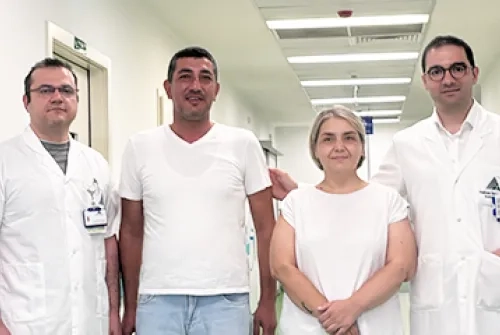
Deniz Ağca, a 42-year-old housewife living in Sakarya, clung to life thanks to a meaningful birthday gift from her husband. Ağca, whose kidneys failed due to diabetes and hypertension diagnosed during her pregnancy, received a kidney donation from her husband of 20 years, police officer İsmail Ağca. Following a successful operation performed by General Surgery Specialist Assoc. Prof. Dr. Veysel Umman and his team at Yeditepe University Koşuyolu Hospital, the Ağca family regained their health.
Deniz Ağca, a mother of two who was diagnosed with diabetes during her pregnancy 16 years ago, struggled with hypertension, vision loss, and weight problems over the years. She underwent gastric bypass and cataract surgeries. However, during a follow-up checkup, it was determined that Deniz Ağca's kidneys had completely failed, and a kidney transplant was necessary.
Health Problems That Started During Pregnancy Led to Kidney Failure
Deniz Ağca described her experience as follows: "I was diagnosed with diabetes when I became pregnant. I have been using insulin ever since. It ran in my family—my mother, sister, and brother also had it—so it was genetic. I continued using insulin after giving birth. However, I also had a weight problem that persisted for many years, so I decided to have gastric bypass surgery two years ago. I lost 30 kilos after the surgery, and my diabetes was brought under control. But I guess because it was genetic, it didn't go away completely; my levels were just low."
Ağca, who began to experience vision problems over time, said, "My vision started to become blurry. When I went to the doctor, I learned I had cataracts. I had surgery, and then bleeding started. My eyes underwent laser treatments. Meanwhile, the doctor who examined the back of my eyes recommended that I regularly check my blood pressure. When I went home and measured it, I was very surprised to find it was 19. Because I had no symptoms, no pain. I hadn't received any other signals from my body."
“My Introduction to Dialysis, the Moment Everything Changed”
The tests conducted after the rise in blood pressure revealed that Deniz Ağca's kidneys were no longer functioning. She described her shock and the impact this process had on her with these words: “I went to the internal medicine department at the state hospital. After looking at the results, the doctor said, ‘Your kidneys have failed. You need a transplant.’ My world came crashing down.” Because I had never had kidney pain before, and since I was able to urinate, I thought I was fine. Then I met Prof. Dr. Gülçin Kantarcı, a nephrology specialist at Yeditepe University Koşuyolu Hospital, and Assoc. Prof. Dr. Veysel Umman, who oversaw the transplant process. Even though I knew I was in good hands, I was very scared. During this process, I had to start dialysis. For about two months, I went on dialysis three days a week for four hours each time."
“My Husband Gave Me His Kidney as a Birthday Present”
When she was told she needed a transplant, the first thought that crossed her mind was that it would open the door to a development that would keep her alive. Deniz Ağca described her feelings as follows: "When they told me I needed a kidney transplant, the only thing that came to mind was, 'I can't ask anyone to give me their kidney.' My husband heard me say this on the phone. He said, ‘You don’t need to look for a kidney. I’ll give you mine as a birthday present.’”
“I Felt Relieved When I Learned Being a Donor Wouldn’t Affect My Job”
Deniz Ağca's husband, police officer İsmail Ağca, described his feelings upon learning of his wife's kidney failure and his decision to be a donor: “When my wife said, ‘Who will I get a kidney from?’, I said to myself, ‘Don't worry, I'll donate mine to you.’ I didn't want her to be upset.” Our analysis and examination process began, and once our tissue compatibility was confirmed, I made my final decision.“ Ağca stated that his biggest concern before making this decision was whether it would affect his career, and continued: ”I was worried about whether it would affect my job. Our professors assured me that there would be no restrictions and that I could continue my work. This assurance put me at ease. We also learned that we would not have to pay any fees for the transplant process and that everything would be covered by the state, which put us even more at ease."
Assoc. Prof. Dr. Umman: “Transplantation Was the Only Solution for This Patient”
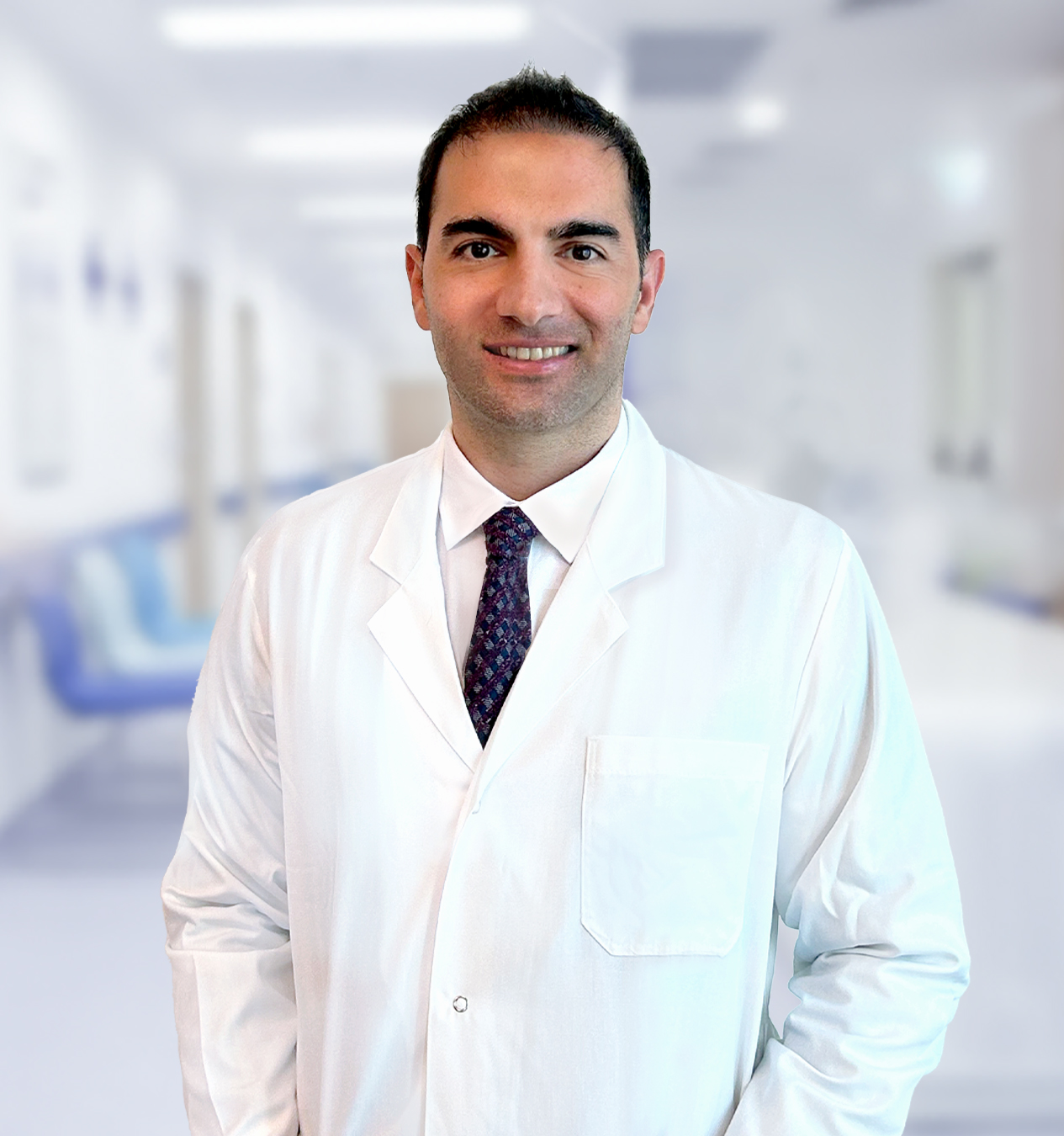
Assoc. Prof. Dr. Veysel Umman, Head of Organ Transplantation at Yeditepe University Koşuyolu Hospital and General Surgery Specialist, stated that Deniz Ağca's kidney functions had irreversibly deteriorated and that transplantation had become inevitable, providing the following information: "When Ms. Deniz came to us, she was quite tired, exhausted, and physically and psychologically vulnerable. She had been under observation for several months due to chronic kidney failure and was undergoing kidney transplant research. Ms. Deniz's situation was somewhat unique. In addition to diabetes, she had undergone obesity surgery and had hypertension. These diseases had damaged the structure of her kidney vessels, leading to a gradual loss of function over time. Her kidneys were no longer working, she had entered dialysis, and a transplant was the only solution."
The Transplant Decision Was Made by the Council
Assoc. Prof. Dr. Umman stated that the patient underwent detailed evaluations by the multidisciplinary transplant council within the hospital and described the operation process: "The patient and the potential donor were thoroughly evaluated with the participation of specialists from nephrology, surgery, and other relevant branches. Recipient-donor compatibility tests were performed. After deciding that both the recipient and the donor were suitable for surgery, we performed a successful transplant operation that lasted approximately 5-6 hours."
Emphasizing that this case was also challenging in surgical terms, Associate Professor Umman explained: "There were two important factors that made Ms. Deniz's surgery more difficult than normal. The first was our patient's high body mass index. This required us to work in a deeper area when placing the kidney and making the new vascular connections, which made surgical access quite difficult. However, the main difficulty was that the vessels to which the kidney would be connected were damaged and covered with plaque due to both diabetes and hypertension. In this situation, meticulous work was required to find a suitable vascular area, clean the plaque inside the vessels, and ensure uninterrupted blood flow."
Both Our Patient and Donor Are in Good Condition
Assoc. Prof. Dr. Umman stated that the postoperative period went smoothly and that both the patient and donor have returned to their daily lives in good health: “Mr. Ismail is currently resting and will return to work soon. Ms. Deniz has adapted to her daily life, and there have been no complications.”
'Early Diagnosis Can Prevent Kidney Failure'
Assoc. Prof. Dr. Veysel Umman emphasized the importance of controlling diseases that lead to kidney failure at an early stage and concluded his remarks as follows: "Diseases such as diabetes and hypertension can result in organ failure if not controlled in time. Diabetes is a disease that can be neglected, as it is considered chronic and hereditary, and it is thought that one can live with it for a long time. However, it secretly damages the entire vascular network of the body, from the eyes to the kidney vessels. Although our patient underwent obesity surgery, she regained weight and her diabetes persisted. It is crucial for this patient group to be aware of all the damage caused by diabetes, especially kidney damage. Early diagnosis is invaluable in preventing such dramatic outcomes. However, if kidney failure has developed and a compatible donor can be found, transplantation is a solution that can save the patient's life.
About
Faculty and Year of Graduation:
Yeditepe University, 2010
”
See Also
- How Should Home Care Be After a Kidney Transplant?
- Fall from Height Led to Kidney Failure, Saved by Sister's Donation
- What is a Liver Transplant, How is it Done? and Who is it For?
- Journey of Hope from Georgia to Turkey: 63-Year-Old Father Donates Kidney to Son
- Can Liver Cancer Be Prevented?
- Common Misconceptions About Kidney Transplantation
- 19 Years Old Davut MİNAZ, Who Lost 45 Kilos in 4 Months, Clung to Life with His Father's Kidney
- What are the Problems Requiring Gallbladder Surgery?
- Gallbladder Surgery is a Necessity, Not a Choice
- What is Organ Donation?
- Liver Cancer (Tumor) and Treatment
- What is a Kidney Transplant?
Alo Yeditepe
Our Related Doctors
Our Services